Your cart is empty.

Your cart is empty.
16 Feb 2026 Sexual Harassment
An overview of why preventing workplace sexual harassment requires cultural change, group learning and specialist facilitation, and how Respect the Line supports safer, more respectful workplaces.
Sexual harassment remains far too common in Australian workplaces. The Australian Human Rights Commission’s Time for Respect: Fifth National Survey on Sexual Harassment in Australian Workplaces found that one in three workers (33%) have experienced workplace sexual harassment in the last five years, with one in five (20%) experiencing it within the 12 months prior. These figures highlight that sexual harassment is not a rare or isolated issue. It is widespread, persistent, and deeply harmful.
The Respect@Work: Sexual Harassment National Inquiry Report (2020) makes clear that sexual harassment is not simply inappropriate behaviour or a workplace misconduct issue. It is recognised as a form of gendered violence. The report emphasises that “the same social norms, structures, attitudes, and practices that drive violence against women are the drivers that enable sexual harassment”.
Research consistently shows that gender inequality is one of the strongest and most reliable predictors of violence against women. These gendered drivers create the social conditions in which harmful behaviours are more likely to be tolerated, minimised, or repeated.
Importantly, violence against women is not inevitable. It is driven by entrenched but changeable social and environmental factors, which means it is preventable. When workplaces address the underlying drivers, they can create safer, more respectful cultures where everyone can thrive.
Everyone deserves to feel safe and to be treated equally at work. That is why we are committed to tackling the root causes of sexual harassment through meaningful, evidence-based workplace training. By supporting organisations to build cultures of respect, accountability, and gender equality, we can help prevent harm before it occurs and create lasting change.
Why our workshop Is Designed as a Four Hour, In Person, Participatory Workshop
Preventing workplace sexual harassment requires more than awareness, compliance, or policy knowledge. Effective prevention goes further by strengthening shared attitudes, practical skills, and workplace norms, so respectful behaviour is consistent, supported, and sustained over time.
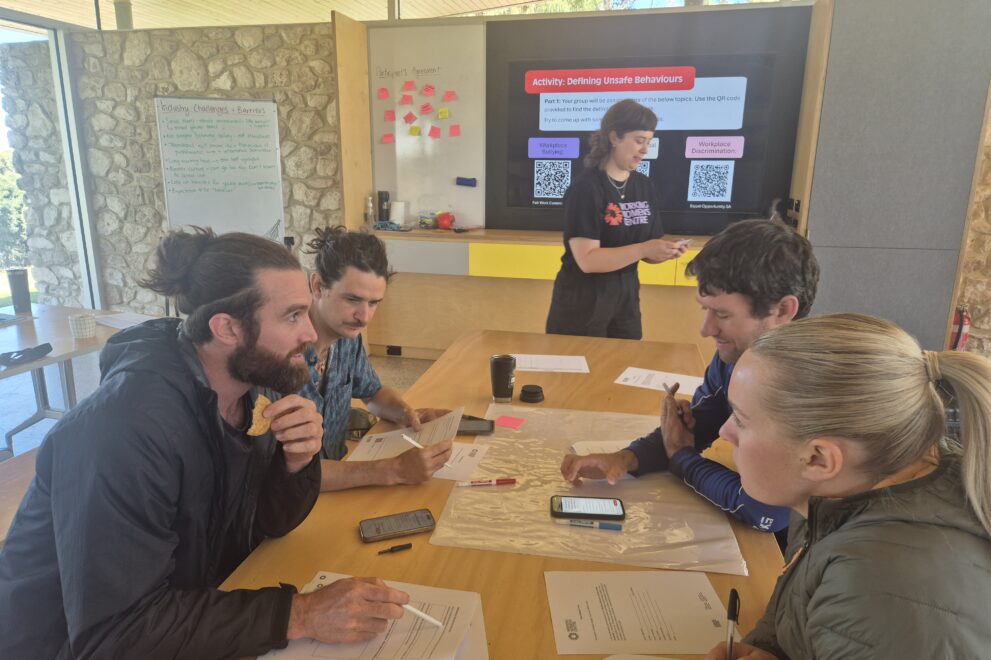
That is why our workshop, Respect the Line, was designed as an in person, participatory workshop delivered over four hours. The length, format, and facilitation style are intentional; they reflect what the evidence tells us about how meaningful workplace change actually happens.
Sexual Harassment Is a Cultural Issue, Not Just an Individual One
Workplace sexual harassment is driven by social norms, power imbalances, and unhelpful attitudes about gender, respect, and entitlement. This is consistently highlighted in Our Watch’s Change the Story framework and the Australian Human Rights Commission’s Respect at Work report. This is a systemic cultural issue, rather than just ‘a few bad apples’.
While understanding legal obligations and reporting pathways is important, education that stops there does not prevent harm. Attitudes and beliefs are harder to shift than knowledge or skills, and they require different learning approaches.
If the problem is social and cultural, then the response must also be collective.
Why Group Learning Matters
Sexual harassment is often normalised through workplace culture. Addressing it at an individual level alone risks missing the conditions that allow it to continue.
Respect the Line is grounded in group-based learning through discussion, reflection, listening, and shared problem solving. This approach is often referred to as the Socratic method, where learning happens through guided conversation, thoughtful questioning, and shared insight. It allows participants to learn from one another, challenge assumptions, and collectively reset expectations about respectful behaviour and care in the workplace.
Delivering training to whole teams together is critical. It creates shared language, shared commitment, shared standards, and shared accountability. It also enables facilitators to respond in real time, assess attitudes in the room, and tailor conversations to the specific risks and realities of each workplace.
Respect the Line can also be delivered online when needed, particularly for regional workplaces or where in person delivery is not possible. However, our strong preference is always face to face. In person delivery allows for deeper engagement, stronger discussion, and a more responsive learning environment.
For these reasons, e-learning modules on their own are not appropriate for the prevention of workplace sexual harassment. They may contribute to compliance, but they cannot shift behaviour and culture.
Designed for Adult Learners
Our workshops use interactive adult learning approaches that prioritise engagement, reflection, and real world workplace application rather than lecture style delivery.
Adults bring lived experience, existing knowledge, and deeply held beliefs into the room. Effective learning starts there.
Key principles in the workshop include:
Why This Training Requires Specialist Facilitators
Workplace sexual harassment training is complex and sensitive. It requires facilitators who are skilled in adult education, experienced in working with vulnerability, and confident in managing challenging questions while maintaining a psychologically safe space.
This work cannot be delivered effectively through scripted content alone. It requires professional judgement, adaptability, and a trauma informed approach. That is why we treat this training as a specialist role.
Why Four Hours Matters
Short sessions may communicate definitions and legal requirements, but they do not allow enough time for reflection, discussion, skill building, and cultural reset.
Our experience tells us that meaningful preventative learning requires time. Four hours allows deeper engagement, safer conversations, and practical application without rushing or oversimplifying complex issues.
Shifting culture takes skill, care, and collective commitment. Four hours is not excessive when the goal is safer, more respectful workplaces where people can thrive.
At its core, Respect the Line equips workplaces with the tools, confidence, and shared responsibility to prevent harm before it occurs.
If you’re interested in booking meaningful training for your workplace, make an enquiry with us today.